

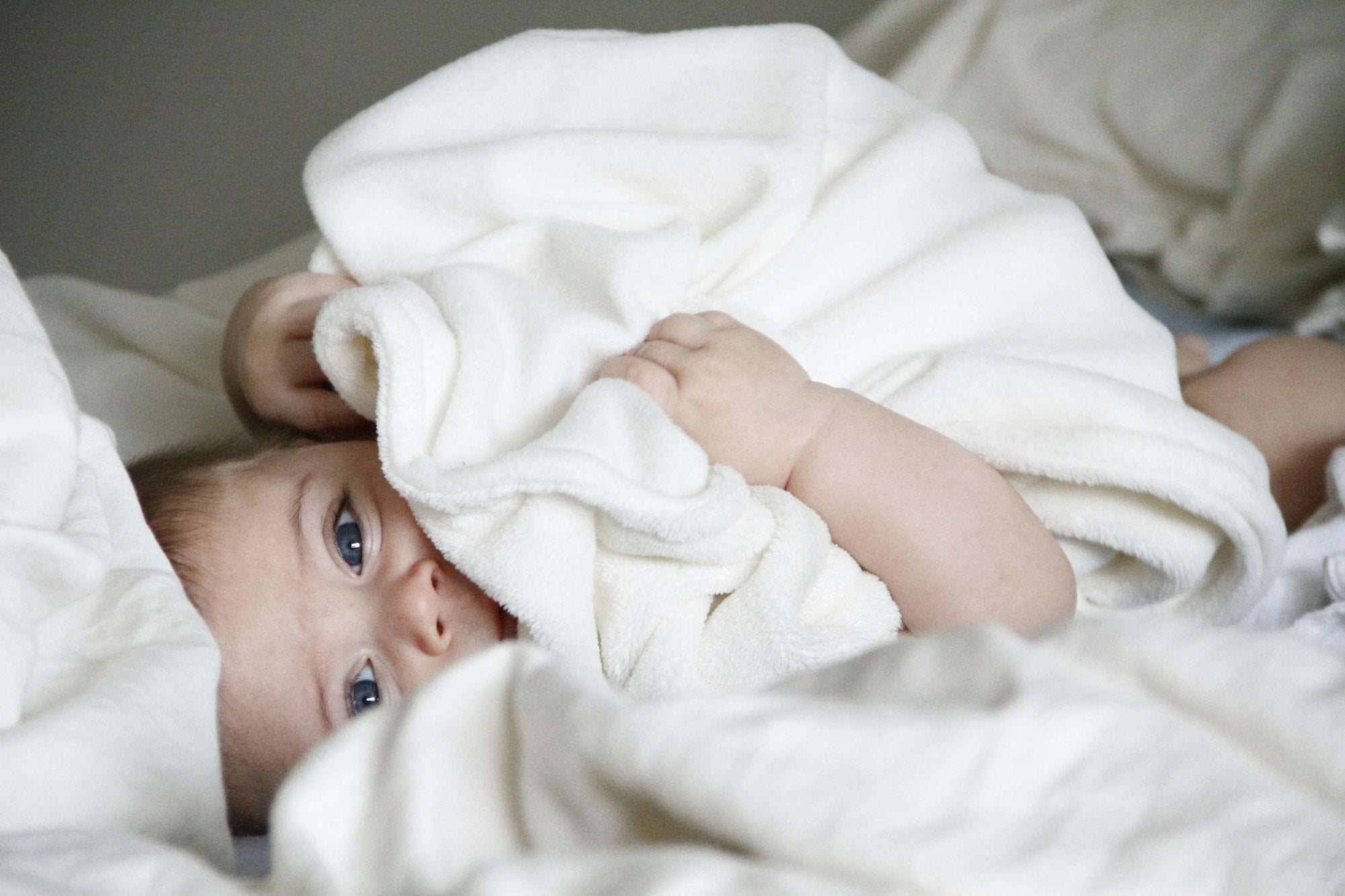
When setting up the future nursery, the question of choosing bedding quickly arises. Beyond its aesthetic appeal, bedding for a newborn must meet certain requirements that aren’t necessarily found in bedding for children or adults.
A newborn will spend many hours in bed—specifically, in contact with the mattress and bedding. Choosing the right baby mattress and bedding is therefore crucial to ensuring a newborn gets a good night’s rest. What materials should you look for in baby bedding? How should you prepare a newborn’s crib? Here are answers and tips for everyone who is excited to welcome a new baby.

What should you put in a baby's crib?
While for many of us a comfortable bed means plenty of comforters, throws, and pillows, a baby’s bed should be much more minimalist when it comes to bedding. In fact, for a newborn’s safety, it’s absolutely out of the question to leave pillows or blankets in the crib. A baby just a few months old doesn’t have the motor skills needed to remove a blanket or pillow that might accidentally end up over their face, posing a risk of suffocation.
Therefore, the only essential bedding item for a baby is a fitted sheet. No other bedding should be placed in a newborn’s crib. Of course, a small, baby-safe comfort blanket can be added to this minimalist bedding set.
What about the pillowcase? Should a baby have a pillow? During the first few months of life, a newborn’s abdominal and back muscles aren’t developed enough to protect its spine. Therefore, a baby should sleep on a firm mattress without a pillow. The baby’s spine must be perfectly aligned. This position also helps the newborn breathe more easily. A pillowcase is therefore not necessary.
Blanket or sleeping bag?
For newborns, blankets and flat sheets are not recommended. This is because a newborn does not have the strength or reflexes to pull a blanket or sheet over its face.
Therefore, until the child has developed the basic motor skills needed to roll over and remove any clothing that might be in the way, the baby should be comfortably covered with a sleep sack, also known as a baby sleeping bag.
Sleep sacks are recommended until the child is at least 18 months old. Others recommend waiting until the child is 2 years old. The most important thing is to adapt to the child’s development. In any case, there are sleep sacks suitable for children up to 3 years old.
After outgrowing the sleep sack, the child can start using bedding like a big kid, including a comforter or blanket.
How to Choose a Fitted Sheet?
As you can see, the fitted sheet is the bed linen you’ll most commonly find in a baby’s crib. You should choose a fitted sheet carefully. After all, the fitted sheet is the fabric that will come into the most contact with a baby’s skin. Without a pillow, the baby’s face will be in direct contact with the fitted sheet for many hours each night and day.
The composition of the fitted sheet is therefore crucial to prevent a baby from coming into contact with potentially toxic or allergenic substances.
When it comes to fitted sheets, cotton remains the best choice of fabric. Cotton is known for its breathable properties. What’s more, you can find fitted sheets made from 100% organic cotton. This allows you to combine the benefits of cotton with a composition free of controversial chemicals.
To ensure that the fitted sheet you choose for your baby’s bedding is not made with or treated using chemicals, you can rely on several certifications. The Organic certification guarantees that the sheet is made of 100% organic cotton. The OEKO-TEX® STANDARD 100 certification, meanwhile, ensures that the fabric does not contain any harmful or controversial substances.
When it comes to the quality of fitted sheets, all new parents will advise you to choose bedding with a minimum thread count.
A cotton percale fitted sheet for babies with a thread count of 80 threads per square centimeter is more durable and better able to withstand a baby’s movements and repeated washings. In fact, a fitted sheet can quickly become stained after a diaper leak or when the baby has a bowel movement. As a result, you’ll likely need to wash your child’s fitted sheets regularly.
In addition, cotton percale feels incredibly soft to the touch. For a baby with delicate skin, the softness of cotton percale will provide the greatest comfort.
In addition, cotton has excellent absorbency, which is highly valued for a baby’s bed. If the baby sweats while sleeping or drools in their sleep, the cotton can absorb most of that moisture. In contrast, a polyester fitted sheet does not absorb moisture as well.
Should you use a mattress protector?
If you want to protect the baby's mattress, you can place a mattress protector between the baby's mattress and the fitted sheet. This waterproof mattress protector has a thin plastic layer that protects the mattress from spills.
It's worth noting that high-quality baby mattresses often come with a removable cover. A baby mattress with a removable cover allows you to wash the cover when necessary.
When it comes to the composition of a mattress protector or mattress cover, cotton is once again the most suitable fabric. Otherwise, there’s little point in choosing a cotton fitted sheet if the mattress protector or mattress cover contains synthetic polyester fibers.
To ensure that your baby’s bedding is breathable and gentle on their skin, you can also choose mattress protectors and mattress covers certified by the Organic or OEKO-TEX® STANDARD 100 labels.
One last practical tip: Choose a mattress pad or mattress cover that can be easily removed from the baby’s crib. A mattress pad is often easy to remove, but a mattress cover can be more difficult to take off the mattress. Therefore, choose a removable mattress cover that has a zipper on several sides of the mattress.
For a chemical-free crib, also choose a 100% natural mattress, such as a natural latex baby mattress. This way, your baby can sleep soundly in a crib that contains no chemical components or treatments. This type of mattress and bedding also allows the crib to breathe better, helping to limit the growth of bacteria and dust mites that can trigger allergic reactions.
We recommend these other pages:
- How to Choose Linen Bedding?
- How to Choose Cotton Gauze Bedding?
- How to Choose Percale Bedding?
- How to Choose Cotton Satin Bedding?
- How to Choose Flannel Bedding?
- What makes high-quality bedding?
- How to Choose a Pillowcase
- How do you choose a duvet set?
- How to Choose a Fitted Sheet?
- How to Choose a Duvet Cover?